
|
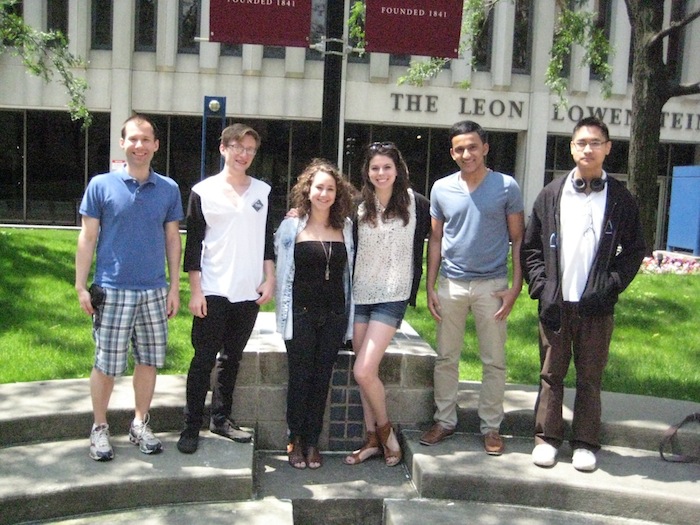 | 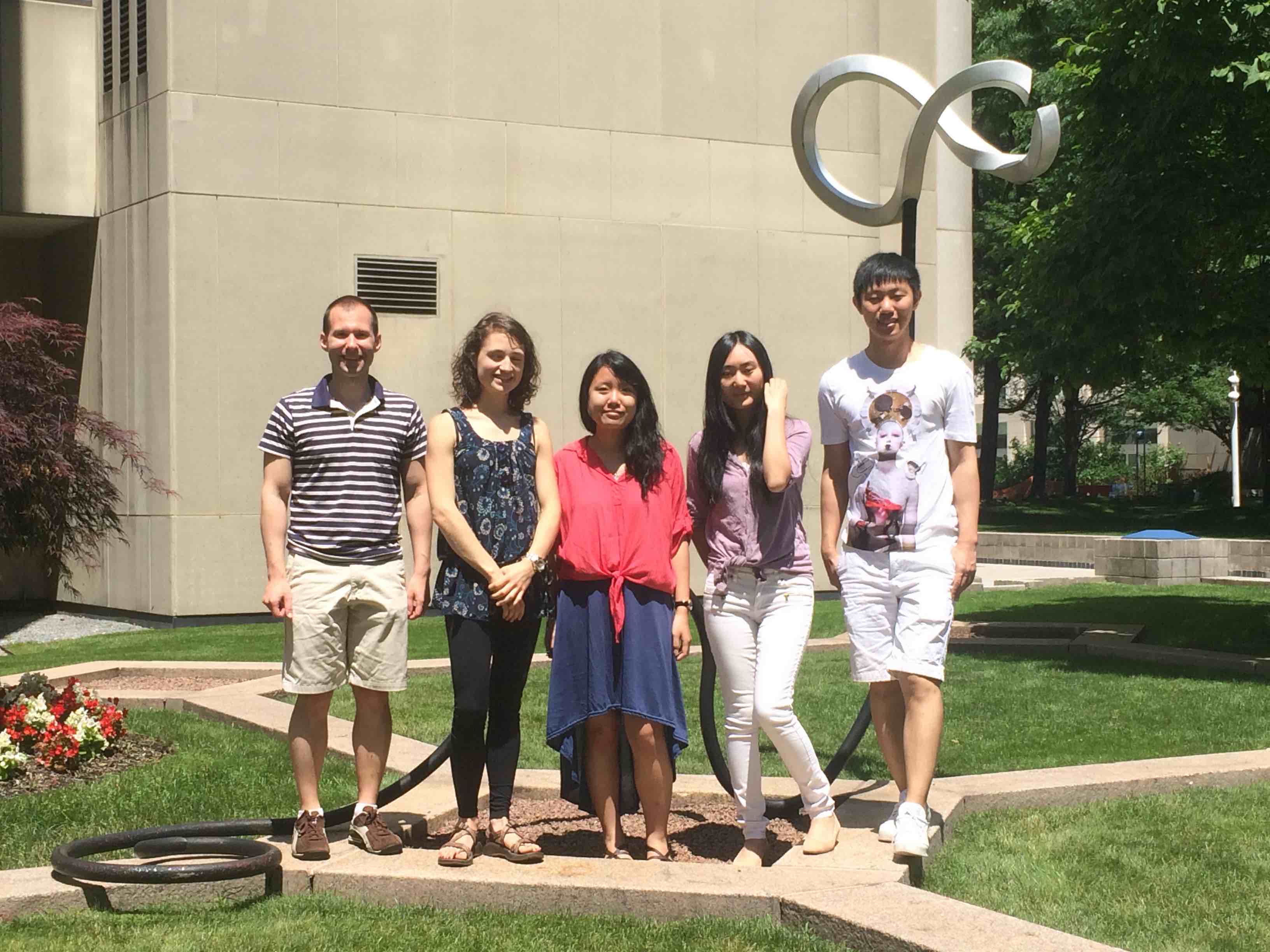 |
| Left to right: David Swinarski; Zak Wills; Lauren Vogelstein; | Left to right: David Swinarski; Natalie Hobson; |
| Amy Barker; Muhammad Ahsan; John Wu. | Katherine Lee; Amanda Lu; Ruiju Wang. |
| June 1, 2012 | June 18, 2014 |
Many projects are available for interested students! Some possible topics include:
Ana Pires has recently joined the Fordham faculty at Lincoln Center and may have additional opportunities for undergraduate research.
Amy Barker (FCLC '14), Lauren Vogelstein (FCLC '13), and John Wu (FCLC '14) worked with me on a new proof of a formula for the fusion rules for the Lie algebra \( \mathfrak{sl}_3 \). A formula for the fusion rules for \(\mathfrak{sl}_3\) was published in 1992 by Bégin, Mathieu, and Walton. Their derivation uses the depth rule. Our approach was to use the Kac-Walton algorithm instead, avoiding the depth rule. Our approach is heavily computational and relies on a computer program run in the computer algebra system Macaulay2. Our work was published in 2015 in the Journal of Mathematical Physics.
John Wu also began a preliminary investigation of multiplicities, tensor coefficients, and fusion coefficients for the root system \( G_2 \).
Zak Wills (FCLC '13) and Muhammad Ahsan (FCLC '15) studied the cone of conformal block divisors associated to the Lie algebra \(\mathfrak{sl}_2\) on the moduli space \( \overline{M}_{0,6} \). In a 2012 preprint, I determined which extremal rays of the nef cone of \( \overline{M}_{0,6} \) are \(\mathfrak{sl}_2\) conformal block divisors. However, many questions remain open. Is the cone of all \( \mathfrak{sl}_2\) conformal block divisors finitely generated? ( A priori this is not obvious, as the level can be arbitrarily large.) If it is, can we determine precisely a value of the level \( \ell_0 \) so that the cone is generated by conformal blocks of level \( \ell \leq \ell_0\)? Does the cone of \(\mathfrak{sl}_2\) conformal blocks have any extremal rays that are not also extremal rays of the nef cone?
Katherine Lee (FCLC '16), Amanda Lu (FCLC '15), Ruiju Wang (FRCH '15), and Natalie Hobson (graduate student, University of Georgia) worked with me in Summer 2014 to study fusion rules for the Lie algebra \( \mathfrak{sp}_4 \) (root system \(C_2\)). We created a graphics program to compute weight diagrams for irreducible representations of \( \mathfrak{sp}_4 \) and identified eight regions within these diagrams where the multiplicities displayed patterns. We used these patterns to generate polynomial formulas for the multiplicities, and are using a theorem of Dehy (2000) to prove our formulas. We also adapted Barker, Swinarski, Vogelstein, and Wu's program (see above) to compute the fusion rules of \( \mathfrak{sp}_4 \) from these multiplicities.
So far, the students' work has resulted in five posters, a senior thesis, and two published journal articles: