Books I
Liked Last Year*
• Marina Benjamin / Rocket
Dreams: How the Space Age Shaped Our Vision of a World Beyond (2003): This is a superb piece of cultural
history masquerading as personal memoir. For anyone interested in the
idea of the ‘space age’ but bored by the minutiae of technology and the
obsessions of space geeks, this is a window into the world of space in
American culture of the past forty years. 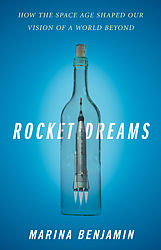 Her principal question is to explain why we no longer live in the
‘space age’ (ask anybody on the street and it’s the ‘information age’
or similar catch phrase.). In other words, on a meta level, this is
also an exploration of how certain historical periods are associated
with certain ideas and ethos. There is much in this book that, I think,
is relevant to space historians who unfortunately remain mostly
interested in artifacts and individuals instead of communities and
cultures. Although the book isn’t entirely successful (it asks too many
questions and tries to answer too few), it’s another interesting
contribution to rewriting American space history---without using the
government, the spacecraft, or the astronaut as its objects of study.
Her principal question is to explain why we no longer live in the
‘space age’ (ask anybody on the street and it’s the ‘information age’
or similar catch phrase.). In other words, on a meta level, this is
also an exploration of how certain historical periods are associated
with certain ideas and ethos. There is much in this book that, I think,
is relevant to space historians who unfortunately remain mostly
interested in artifacts and individuals instead of communities and
cultures. Although the book isn’t entirely successful (it asks too many
questions and tries to answer too few), it’s another interesting
contribution to rewriting American space history---without using the
government, the spacecraft, or the astronaut as its objects of study.
• Roane Carey and Tom Segev, eds., The Other
Israel: Voices of Refusal and Dissent (2004): This is a collection of
essays by Israeli and/or Jewish intellectuals on the
Israeli-Palestinian conflict who strongly disagree with and are
critical of the policies of recent Israeli governments in the Occupied
Territories. Authors include Uri Avnery, a veteran of the 1948 war who
served in the Knesset, Ishai Menuchin, a Major in the Israeli Defense
Forces reserves, and Dr. Yigal Shochat who served as a fighter pilot in
the Israeli Air Force. These are very brave people for eloquently and
fearlessly writing about how the Israeli government's poor treatment of
Palestinians (as well as Israeli Arabs within Israel) is not only
morally inexcusable but also undercuts and subverts any claim to Israel
being a democracy. They also distinguish between criticism of Israel
and anti-Semitism, a distinction that seems to be lost in the
increasingly shrill discourse on the Israeli-Palestinian issue in the
U.S. The authors handle many difficult questions and not all of them
agree with each other, but their voices and arguments are important,
not the least because their positions are so nearly shut out of the
mainstream American media. Anthony Lewis, the former columnist for the New
York Times writes an informative and moving introduction to the
book.
• Douglas Coupland / Hey
Nostradamus! (2003): It's been a while since I've read a book
by Coupland but this definitely convinced me (again) of the genius of
this man. On the surface, this is a story about four people who were
affected in different ways by a school-shooting (a la Columbine)
circa the late 1990s.
Not afraid to tackle the big issues (mortality, God), he goes a good
distance without any hint of being pretentious, ponderous, or
contrived. A simply fantastic novel, the book was hard to read at
times, hard to put down at
others. 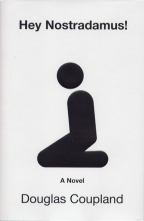 I have a weakness
for books on death and the ways in which regret and contingency are
tied to it. Alice Sebold's The Lovely Bones (2002) was a
powerful meditation on those relationships. But where Sebold eventually
was unable to refrain from ultimately embracing a forced and neat
(=Hollywood) version of death, regret, and contingency, Coupland
addresses these issues without blunting the rough edges. There is also
a believable arc of redemption here in one of the central characters,
and no, it's not one of the perpretrators of the crime. There is a
really cool site
dedicated to this book, with accompanying music and showing art
installations by Coupland himself. Check out the animation, it's
haunting.
I have a weakness
for books on death and the ways in which regret and contingency are
tied to it. Alice Sebold's The Lovely Bones (2002) was a
powerful meditation on those relationships. But where Sebold eventually
was unable to refrain from ultimately embracing a forced and neat
(=Hollywood) version of death, regret, and contingency, Coupland
addresses these issues without blunting the rough edges. There is also
a believable arc of redemption here in one of the central characters,
and no, it's not one of the perpretrators of the crime. There is a
really cool site
dedicated to this book, with accompanying music and showing art
installations by Coupland himself. Check out the animation, it's
haunting.
• Fyodor Dostoevsky / Crime
And Punishment (1866): Well, what could I
possibly say about this book that would be insightful or remotely
original. Good story though. Heavy. Very heavy.  The story is basically this: some dude
commits a crime for no reason
at all (really) and then gets away with it. Then consumed by guilt, he
meets a beautiful prostitute who has had the most difficult life
imaginable.
Anyway, he's afraid to tell her that he committed this heinous crime,
but....wait, I can't tell you the whole story. Anyway, there's a little
bit of both (crime and punishment) covered in nearly a thousand pages.
Not quite as punk rock as Notes From Underground!, this is more
like his Blonde On Blonde
rather than his Fun House.
The story is basically this: some dude
commits a crime for no reason
at all (really) and then gets away with it. Then consumed by guilt, he
meets a beautiful prostitute who has had the most difficult life
imaginable.
Anyway, he's afraid to tell her that he committed this heinous crime,
but....wait, I can't tell you the whole story. Anyway, there's a little
bit of both (crime and punishment) covered in nearly a thousand pages.
Not quite as punk rock as Notes From Underground!, this is more
like his Blonde On Blonde
rather than his Fun House.
• Bob Dylan / Chronicles Volume 1 (2004): All this time I thought that Bob had
become a bumbling, inarticulate, senile fool, and lo and behold he
comes out with all four cylinders firing in a tour de force of
writing. Ostensibly an autobiography, this is unlike most biographies
one might read, since it is wholly non-linear (he skips from 1961 to
1987 to 1967 to 1961). His prose is strong and frequently wispy, in
that way that makes the sound of words more meaningful than their
sequence. It's not poetic, just hard to pin down. You read a paragraph
and you get out with some idea of what this is all about but nothing
too concrete. You either get it or you
don't. The section on 1961 is the richest part of the book; Dylan
describes events, smells, books, dust, corners, shapes (and women) of a
life that was on the cusp of form but not yet there. Reviewers have
said that he skipped over all his great albums but who cares? He
(almost) made me want to run over
and buy Oh Mercy (1989) but....OK, I'm not gonna do that. For
those
that care not a whiff about Bob Dylan, this is still a book you can
read
because it's not about Bob Dylan but more of a cultural history of one
possible
American journey, from Minnesota to New York City, and to Dylan's
credit,
he recreates lost feelings without falling into the easy safety net of
polluting
the past with retrospect. The question is whether he made up the entire
book.
Fiction is History is Fiction.
• John Fowles / The Collector (1963): This is one of the most
disturbing novels I’ve read in a long time. The premise is simple, a
lonely, working class man kidnaps a young female university student
women in early 1960s England, during a time of great social changes.
Through the thematic device of class tensions between the two, there is
a story here about rich and poor, stupid and intellectual. But the
equally compelling and much more disturbing story is about the
relationship between the two, about the inevitability and
the horror of the ending, a conclusion I did not expect. This book, if
it
was made into a movie now would have an entirely different ending. Both
main
characters are insufferable in their own ways and Fowles goes out of
his
way to make them unlikable, but it’s hard to keep maintain dispassion
in
the face of such normal people trapped in such abnormal circumstances.
It
could happen to you too, you know. Fowles, of course, also wrote the
brilliant French Lieutenant’s Woman which was much more verbose
and artful. This novel is simple and....odd, one of his early works.
• Chris Hedges / War Is A Force That
Gives Us Meaning (2003): Hedges spent
many years being a journalist in various dangerous locales: Central
America, the Sudan, the Gaza Strip, and the Balkans. This is a short
meditation on humanity's need for war and violence. He gives voice to
the (not so original) idea that cuts across societies, cultures, and
governments, the idea that war is fundamental to the way we live and
negotiate through life. War: we feed on it, we grow with it, we love to
model our heroes from it, we love to measure bravery by it. Yet,
fundamentally, we are detached from the notion that war is, at any
level, sheer and utter horror. War is never noble, it is never 'good,'
it never has a 'greatest generation,' it is merely bayonets ripping
open the stomachs of pregnant women, bombs dropping via cruise missiles
on entire families, armies bulldozing and crushing women and children
under tanks, men and women who blow themselves up to kill others, and
societies that behead/gas/disembowel/torture people systematically
because they look or act different. Yet, war makes us happy. We hide
all the horrors of war by wrapping flags around it. Read it and weep.
• Lauren
Grodstein / Reproduction Is The
Flaw Of Love
(2004):
A novel by a young woman nails many of the anxieties and hormonal
challenges of late '20s coupledom (and everything inbetween).  Grodstein writes wonderfully, spartan but
incredibly sharp, and the story moves along with a natural pace around
a single event: a boy named Miller at the crisis point of finding out
whether his girlfriend is pregnant or not. Maybe I shouldn't say it but
Grodstein is acutely insightful of the ways young males think, a
surprising feat... or maybe we are all just so transparent? By the end,
she raises all those issues that sometimes remain unsaid even in the
best of relationships. She must be in her twenties but has made a bold
start. (Apparently, she teaches at the Cooper Union here in NYC). She
has an equally good book of short stories, The Best of Animals
that may be even better.
Grodstein writes wonderfully, spartan but
incredibly sharp, and the story moves along with a natural pace around
a single event: a boy named Miller at the crisis point of finding out
whether his girlfriend is pregnant or not. Maybe I shouldn't say it but
Grodstein is acutely insightful of the ways young males think, a
surprising feat... or maybe we are all just so transparent? By the end,
she raises all those issues that sometimes remain unsaid even in the
best of relationships. She must be in her twenties but has made a bold
start. (Apparently, she teaches at the Cooper Union here in NYC). She
has an equally good book of short stories, The Best of Animals
that may be even better.
• Naguib Mahfouz / The Thief
And His Dogs
(1961): This is the first book I've read by Nobel Prize
winner Mahfouz (also written as Najib Mahfouz, below) and it was pretty
incredible. It's a short story of a man recently released from prison
who
sets out to kill the man who was responsible for his incarceration. In the process, the former prisoner's life begins to
unravel into complete chaos. The backdrop to the novella is a nation
that has had a traumatic
change in society and politics since the main character moved in and
then
out of jail. Mahfouz (who is still alive) had a beautiful command of
language
(and I'm just reading the English, not the original in Arabic) full of
economy and grace, unlike most of what you'd read today in a novel.
This is not an uplifting story; it's a moving eulogy for a life unable
to let
go of a dream.
In the process, the former prisoner's life begins to
unravel into complete chaos. The backdrop to the novella is a nation
that has had a traumatic
change in society and politics since the main character moved in and
then
out of jail. Mahfouz (who is still alive) had a beautiful command of
language
(and I'm just reading the English, not the original in Arabic) full of
economy and grace, unlike most of what you'd read today in a novel.
This is not an uplifting story; it's a moving eulogy for a life unable
to let
go of a dream.
• Bill Martin / Avant
Rock: Experimental Music From the Beatles to Bjork
(2002): A random book I picked up and got slowly sucked into by dint,
partly, of the author's writing style, which is more like talking than
writing.
He's not condescending, doesn't use jargon, and is never pretentious. I
also liked the fact that he's willing to take on 'uncool' genres in
rock
music that have been discarded because of sheep mentality (e.g.,
anything
to do with punk = good, anything to do with progressive rock = bad).
Dispensing of such received 'wisdom,' Martin (who is a Professor of
Philosophy at DePaul University in Chicago) does a pretty good job of
chronicling the history
and meaning of 'outsider' Western music through the ages. Granted, his
knowledge of post-punk is a little weak (there's no mention of the Pop
Group, barely a mention of Gang of Four and, amazingly, almost nothing
on P.I.L.'s Metal Box) and he clearly knows very little about
the Velvet Underground,
but the spread of this work is amazing, taking in everything from free
jazz
to early experiments with electronic music in the mid-twentieth century
to techno. Be warned, this is somewhat of a personal memoir too, but
not
in a self-absorbed way; he's not here to impress anybody with his
knowledge,
but to chronicle the struggles over the fringe, and how that fringe
frequently
moved to the center, letting others create new fringes. (By the way, I
HATE
Bjork).
*
Obviously,most of these books have nothing to do with 2004. I
just read them last year. Whatever.