José Alemán
Professor of Political Science · Fordham University
Biography
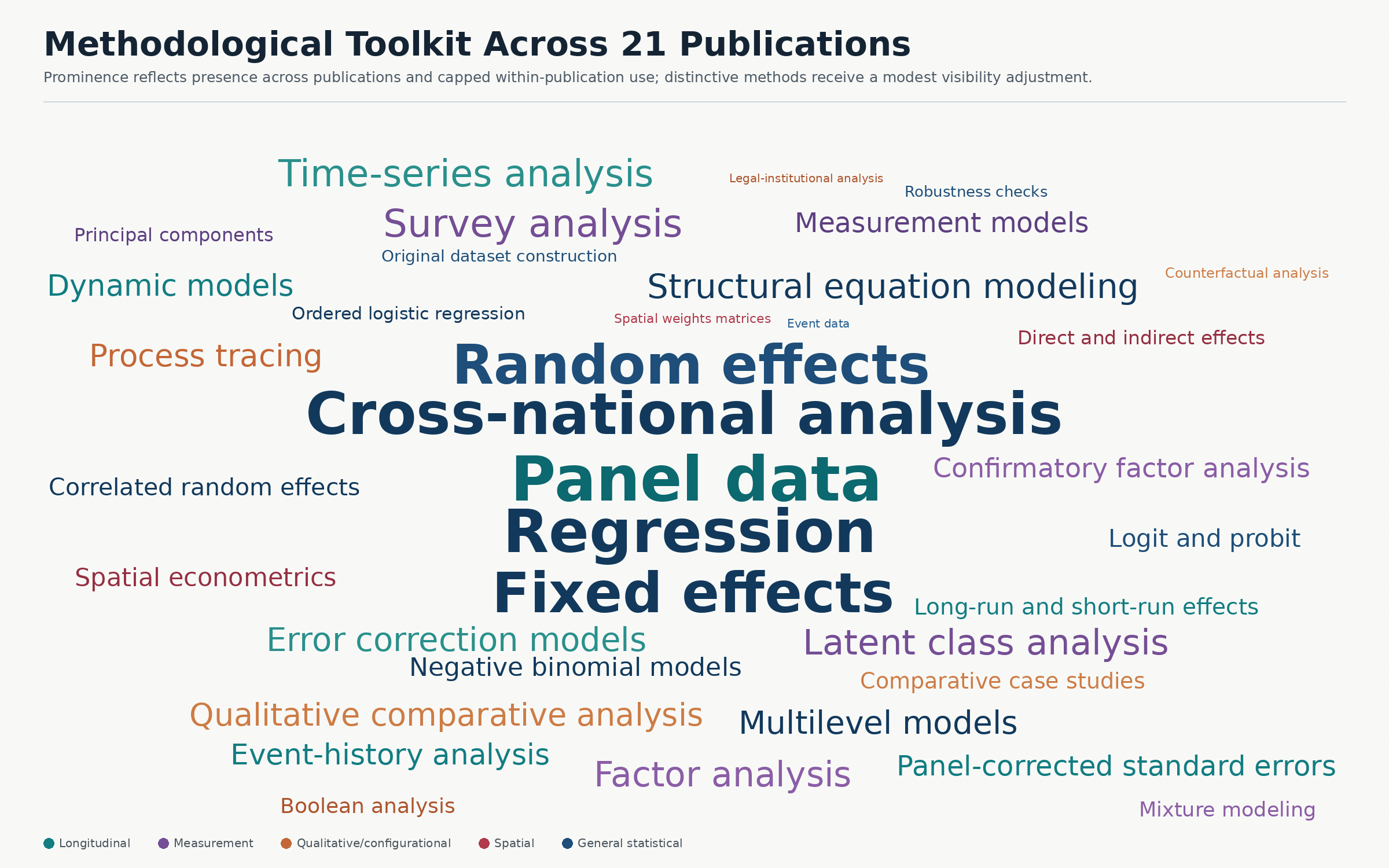
Jose Aleman is Professor of Political Science at Fordham University. He has degrees from Cornell University (B.A.) and Princeton University (M.A., Ph.D.) and teaches courses on Comparative Politics and Political Economy. His work focuses on democratic institutions, social movements, regime change, human rights, and social science methodology. His research employs a broad comparative-methodological toolkit, including longitudinal and multilevel models, event-history and spatial analysis, latent-class and measurement models, qualitative comparative analysis, and comparative process tracing. Professor Aleman is on the editorial boards of the Korea Observer and the Journal of Contemporary East Asia. His work has appeared in the Journal of Human Rights; Korea Observer; methods, data, analyses; Globalization, Security, Development and Global Values: Essays in Honor of Arno Tausch; Peace Studies; International Studies Quarterly; Nations and Nationalism; Migration and Development; the Oxford Handbooks Online; the Oxford Handbook of Employment Relations; Review of European Studies; Social Science Quarterly; Comparative Political Studies; the Industrial Relations Journal; the International Political Science Review; Political Studies; and the International Journal of Korean Studies. He is the recipient of a 2022–2023 Beacon Exemplar Award by the United Student Government of Fordham University “for outstanding service to the Fordham community.”

Publications
Book
Selected articles, chapters, and entries (peer-reviewed)
- “The Capacity Constraint: Performance Legitimation, State Capacity, and Authoritarian Repression” (with Dong Wook Lee). Revise and Resubmit.
- “It is Time to Revisit the External Determinants of State Terror” (with Dong Wook Lee). Journal of Human Rights (2026).
- “Emergency Declarations and The Fate of Military Coups: Evidence from South Korea.” Korea Observer 56 (4): 537–562 (2025).
- “The Dictator's Dilemma: Why Communist Regimes Oppress their Citizens while Military Regimes Torture and Kill.” Journal of Human Rights 22 (3): 284–306 (2023).
- “States of Emergency: In Whose Interest Are They Invoked?” (with Dong Wook Lee and Dwayne Woods). In Glen Segell, ed., Globalization, Security, Development and Global Values: Essays in Honor of Arno Tausch (2023).
- “Confucianism and Corruption: The Sources of Support for Democracy in Northeast Asia” (with Howard Sanborn). Korea Observer 52 (4): 649–675 (2021).
- “Solidarity and Self-Interest: Using Mixture Modeling to Learn about Social Policy Preferences” (with Dwayne Woods). methods, data, analyses 14 (1): 1–30 (2020).
- “Korea's Candlelight Protests in Context: Evidence from the Asian Barometer Survey and Global Events Data.” Peace Studies 27 (1): 313–352 (2019).
- “A Comparative Analysis of Inequality and Redistribution in Democracies” (with Dwayne Woods). International Studies Quarterly 62 (1): 171–181 (2018). (data · code)
- “Inductive Constructivism and National Identities: Letting the Data Speak” (with Dwayne Woods). Nations and Nationalism 24 (4): 1023–1045 (2017).
- “Value Orientations from the World Values Survey: How Comparable are They Cross-Nationally?” (with Dwayne Woods). Comparative Political Studies 49 (8): 1039–1067 (2016).
- “Protest and Institutional Reform.” Oxford Handbooks Online (2015).
- “No Way Out: Travel Restrictions and Authoritarian Regimes” (with Dwayne Woods). Migration and Development 3 (2): 285–305 (2014).
- “The Left Turn in Latin America: Consequences for Employment Relations.” Oxford Handbook of Employment Relations: Comparative Employment Systems (2014).
- “Active or Passive? Reforming Employment Benefits in the OECD.” Review of European Studies 4 (5): 94–108 (2012). Article summary in the ADAPT International Bulletin.
- “Cooperative Institutions and Inequality in the OECD: Bringing the Firm Back In.” Social Science Quarterly 92 (3): 830–849 (2011).
- “A Duration Analysis of Democratic Transitions and Authoritarian Backslides” (with David Yang). Comparative Political Studies 44 (9): 1123–1151 (2011).
- “Labour Market Dualism and Industrial Relations in Europe.” Industrial Relations Journal 40 (3): 252–272 (2009).
- “The Politics of Tripartite Cooperation in New Democracies: A Multi-Level Analysis.” International Political Science Review 30 (2): 141–162 (2009).
- “Labor Market Deregulation and Industrial Conflict in New Democracies: A Cross-National Analysis.” Political Studies 56 (4): 830–856 (2008).
- “Direct Action.” In International Encyclopedia of the Social Sciences, 2nd ed., W. A. Darity, editor in chief (2007).
- “Political Stability.” In International Encyclopedia of the Social Sciences, 2nd ed., W. A. Darity, editor in chief (2007).
- “Protest and Democratic Consolidation: A Korean Perspective.” International Journal of Korean Studies IX (1): 71–90 (2005).
Teaching
My central goal as a teacher is not simply to impart knowledge about politics, but to cultivate in students the same curiosity, enthusiasm, and passion for understanding political life that drew me to the discipline. My teaching connects political science theories and evidence to questions about how governments work, why countries develop differently, and how institutions shape people’s lives. In course evaluations, students frequently highlight my depth of knowledge, use of real-world examples, and thoughtful responses to their questions. They also value opportunities to discuss competing explanations, work through ideas with classmates, and apply concepts to particular countries and events. Through readings, discussion, and empirical analysis, I aim to help students understand complex arguments, evaluate evidence, and develop informed judgments of their own.
Courses
Introduction to Comparative Politics · Political Economy of Development · Political Institutions · International Political Economy
Selected student feedback
“He has an incredible ability to simplify economic concepts, relate them to the real world, and explain their significance.”
“Professor Aleman encouraged us to engage with our peers and synthesize our own explanations for political phenomena, which really helped make sense of all the details and theory in the class materials.”
“I also really appreciated that Professor Aleman responded to comments on Perusall, I've never had a professor do that before. It answered a lot of my questions.”
Comments from official, anonymous student course evaluations.
Toolkit
Contact
Fordham University113 W. 60th Street · Lowenstein, 9th floor
New York, NY 10023
aleman@fordham.edu